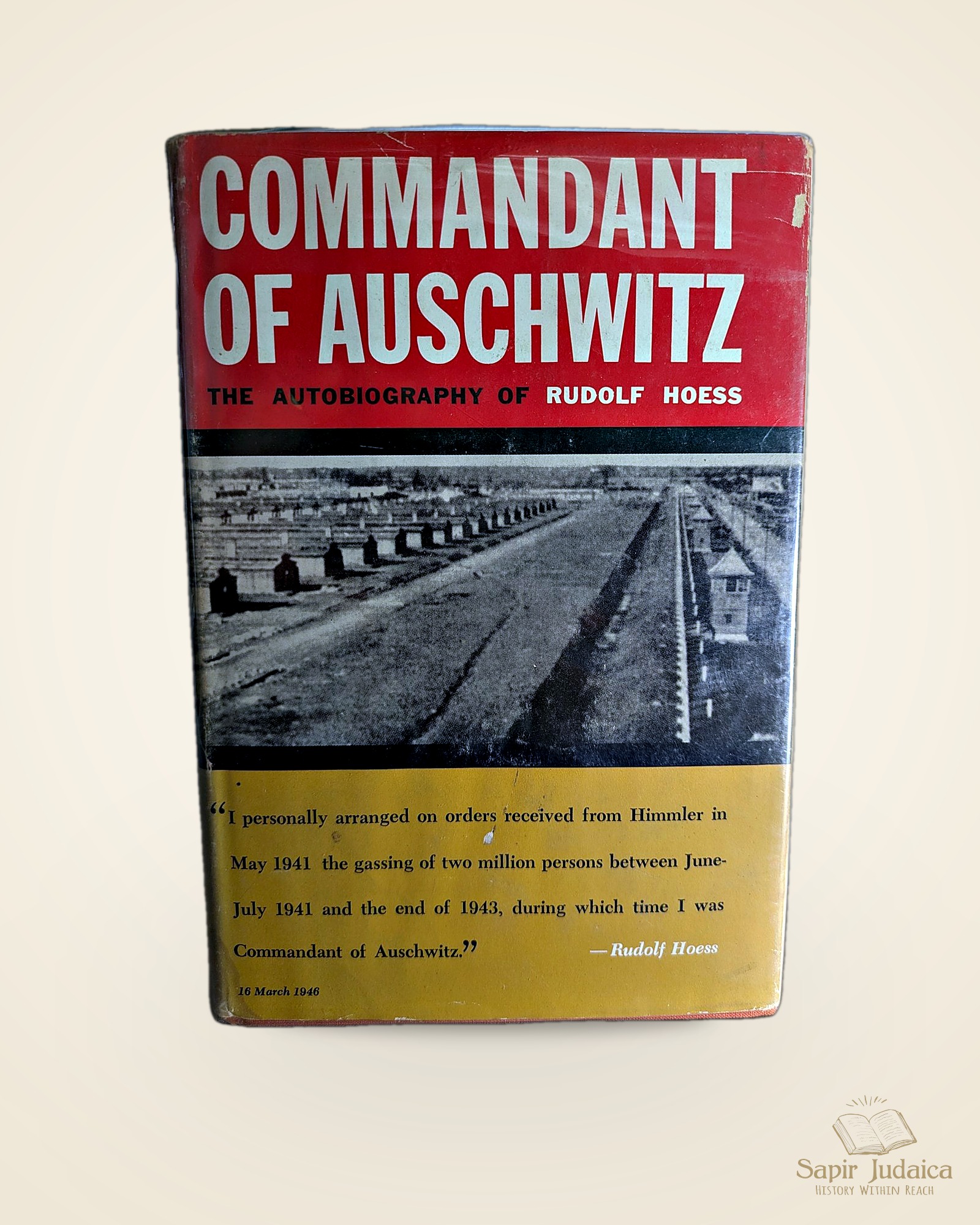
Commandant of Auschwitz - The Autobiography of Rudolf Höss, Written in His Cell Before His Execution. First English Edition, Weidenfeld & Nicolson, London, 1959.
The autobiography of Rudolf Höss, Commandant of Auschwitz from 1940 to 1943 and the man responsible for turning the camp into the largest killing center of the Holocaust, written in his own hand, in his prison cell, in the months between his capture and his execution.
Following his arrest by British forces in March 1946, Höss was handed over to Polish authorities for investigation and trial. In Kraków, the chief investigating judge, Dr. Jan Sehn, who was building the case against him, persuaded Höss to set down his recollections of Auschwitz. What began as investigative material grew into a full memoir: a methodical, dispassionate account of the camp's organization, the mechanics of mass murder, and Höss's own role in carrying it out - written entirely from memory, without access to a single document. Weeks earlier, in April 1946, Höss had already appeared before the International Military Tribunal at Nuremberg as a defense witness for Ernst Kaltenbrunner, where he calmly testified to the deaths of more than two and a half million people at Auschwitz, testimony that remains among the most chilling on record from the entire Nuremberg proceedings.
Höss was tried separately by the Supreme National Tribunal of Poland in Warsaw in March 1947, sentenced to death, and on 16 April 1947 was hanged on gallows erected beside the crematorium of Auschwitz I - executed at the site of his own crimes.
His manuscript was first published in Polish translation in 1951, and in the original German in 1958. This 1959 Weidenfeld & Nicolson edition is the first English translation, rendered by Constantine FitzGibbon with an introduction by Lord Russell of Liverpool, the British barrister and author of The Scourge of the Swastika who had himself been closely involved in the prosecution of Nazi war criminals. Despite, or perhaps because of, its author, the memoir is regarded by historians as one of the most important and reliable primary sources on the internal workings of Auschwitz, precisely for the bureaucratic, unflinching mindset it lays bare.
Condition: Very good for it's time, light age-toning, minor edge wear, small tears to the dust jacket, binding solid.
האוטוביוגרפיה של רודולף הס, מפקד אושוויץ בשנים 1940–1943 והאחראי להפיכת המחנה למרכז ההמתה הגדול ביותר של השואה, שנכתבה בכתב ידו, בתאו בבית הכלא, בחודשים שבין מעצרו להוצאתו להורג.
לאחר מעצרו בידי הכוחות הבריטיים במרץ 1946, הועבר הס לידי הרשויות הפולניות לצורך חקירה ומשפט. בקרקוב שכנע אותו השופט החוקר הראשי, ד"ר יאן סהן, אשר בנה את התיק נגדו, לרשום את זכרונותיו מאושוויץ. מה שהחל כחומר חקירתי הפך לכתב זיכרונות מלא: תיאור שיטתי וקר-רוח של ארגון המחנה, המנגנון של הרצח ההמוני, ותפקידו של הס עצמו בביצועו - נכתב כולו מהזיכרון, ללא גישה לאף מסמך. שבועות קודם לכן, באפריל 1946, כבר העיד הס בפני בית הדין הצבאי הבינלאומי בנירנברג כעד הגנה עבור ארנסט קלטנברונר, שם העיד בקור רוח על מותם של למעלה משני מיליון וחצי בני אדם באושוויץ, עדות הנחשבת עד היום לאחת המצמררות ביותר מכל הליכי נירנברג.
הס הועמד לדין בנפרד בפני בית הדין הלאומי העליון של פולין בוורשה במרץ 1947, נידון למוות, וב-16 באפריל 1947 נתלה על גרדום שהוקם בסמוך לקרמטוריום של אושוויץ I - הוצא להורג במקום שבו ביצע את פשעיו.
כתב היד פורסם לראשונה בתרגום לפולנית ב-1951, ובגרמנית המקורית ב-1958. מהדורה זו של Weidenfeld & Nicolson משנת 1959 היא התרגום הראשון לאנגלית, בתרגומו של קונסטנטין פיצג'יבון, עם הקדמה מאת לורד ראסל מליברפול, עורך הדין הבריטי ומחבר הספר 'The Scourge of the Swastika', אשר היה מעורב בעצמו בקרוב בהעמדתם לדין של פושעי מלחמה נאצים. למרות, ואולי דווקא בשל, זהות מחברו, הזיכרונות נחשבים בקרב היסטוריונים לאחד המקורות הראשוניים החשובים והאמינים ביותר על תפקודו הפנימי של אושוויץ, בדיוק בשל התודעה הבירוקרטית והבלתי מתפשרת שהם חושפים.
מצב: טוב מאוד ביחס לגילו, הצהבה קלה מגיל, בלאי מינורי בקצוות, קרעים קטנים בעטיפת האבק, הכריכה יציבה.
